
How Soft Tissue Injuries Are Diagnosed and Treated After a Car Crash
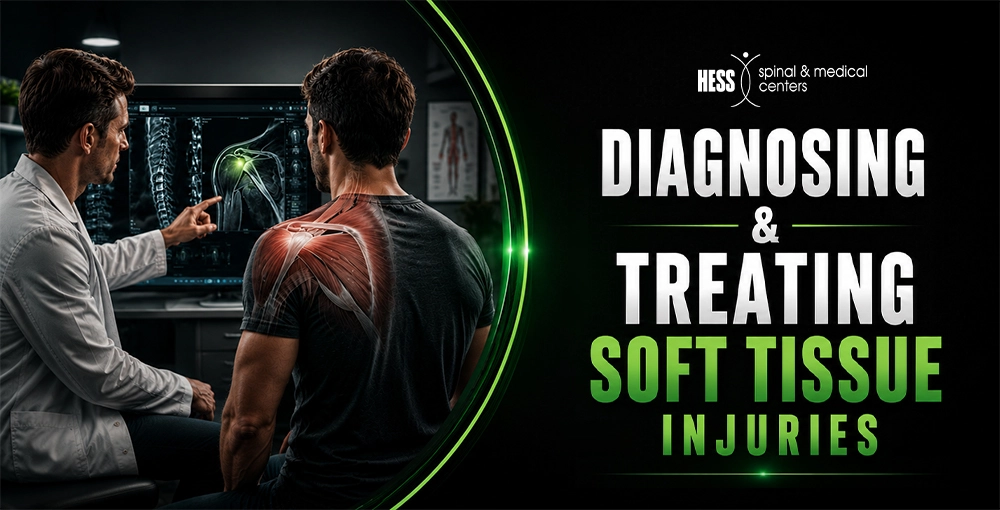
Professional chiropractic and injury rehabilitation graphic illustrating the diagnosis and treatment of soft tissue injuries following a car crash. The image features a healthcare provider reviewing diagnostic imaging with a patient, highlighting the importance of accurate evaluation, medical imaging, personalized treatment plans, rehabilitation therapies, and ongoing care to support recovery from accident-related muscle, tendon, and ligament injuries.
Accident Injury Care | Soft Tissue Injuries
Understanding how soft tissue injuries are diagnosed and treated after a car crash.
Soft tissue injuries are the most common injuries in Florida car crashes. These harm muscles, plus connective fibers like ligaments and tendons. Doctors rely on physical exams, imaging, along with movement analysis to confirm issues. Healing is gradual, the swelling goes down, strength and motion return. Skipping either phase might slow or limit healing.
West Central Florida
(800) 618-4377
Same-day evaluations are available at Hess Spinal & Medical Center locations across West Central Florida.
Key Points
- Soft tissue injuries don't show up well on regular x-rays. That’s why you need an MRI or an ultrasound.
- Stiff neck, back pain and muscle aches might not be fully apparent until 24 to 72 hours after impact.
- Florida PIP law requires that you receive your first medical treatment within 14 days. The longer you wait the less you get.
- Treatment produces the best results from a layered plan that includes chiropractic care, physical therapy and medical evaluation.
- There’s no room for speculation because a multidisciplinary clinic offers both diagnosis and treatment together.
3M+
Whiplash cases reported in the U.S. annually
72 hrs
Window when symptoms commonly peak post-crash
14 Days
Florida PIP window for initial evaluation
80%
Soft tissue injuries with no visible X-ray findings
1
What’s a Soft Tissue Injury After an Automobile Accident?
Not everything is broken bone and visible bruise. Soft tissue injuries hit the body's connective framework. This includes ligaments, fascia, tendons, and muscles. Your body absorbs a tremendous amount of kinetic force in an instant during a collision. Most of it goes in the lower back, neck and spinal.
The most well known type is “whiplash.” The cervical spine flexes quickly back and forth. However, contusions, sprains and strains are equally frequent and equally disruptive. Ligaments suffer in a sprain, torn or stretched beyond normal. When muscles or tendons take harm, that’s called a strain. Both interrupt daily movement.
Most times, pain doesn’t show right away with these kinds of injuries. Thanks to adrenaline, things feel okay at first. Hours pass before the puffiness starts creeping in. This delay explains why someone can leave an accident thinking they are okay.
2
Doctors Find Soft Tissue Injuries Through Exams & Scans
Most times, figuring out the problem means going through several stages. One tool alone rarely gives the full picture. Starting off, doctors rely on physical checks. Your movement limits, nerve reactions, body discomfort guide the evaluation. That initial evaluation tells the doctor where to look deeper.
Standard X-rays rule out fractures, but don’t give a clue regarding the soft tissues. And for genuine muscle, tendon or ligament injury, it has to be an MRI image. MRI captures the full picture. Ultrasound works well for tendon and muscle injuries and gives real-time feedback on inflammation. For nerve involvement, a nerve conduction study may follow.
The diagnosis begins the day you walk into Hess Spinal and Medical Centers. Board-certified medical doctors, osteopathic physicians, and chiropractors work together to map your injury correctly from the start. No referral bouncing. No waiting weeks for clarity.
Digital radiography is available on-site. That matters for documentation, especially when you are working through a Florida PIP claim. A complete, well-documented diagnosis protects both your recovery and your legal standing.
Diagnostic Tool Comparison for Soft Tissue Injuries
| Diagnostic Method | Best For | Soft Tissue Visibility | Available at Hess |
|---|---|---|---|
| X-Ray / Digital Radiography | Ruling out fractures | None | Yes |
| MRI | Ligament, disc, and muscle damage | Excellent | Via referral |
| Ultrasound | Tendon and muscle injuries | Good | Coordinated on-site |
| Nerve Conduction Study | Nerve compression, radiculopathy | N/A (nerve-focused) | Via referral |
| Physical Exam + ROM Testing | Functional impairment baseline | Clinical review | Yes, the same day. |
3
How To Actually Treat Soft Tissue Injuries?
Therapy is an ordered sequence. The goal shifts at each phase.
Phase one controls the acute inflammation. This is the first 72 hours. Trigger point injections relax local spasms of muscles. Ultrasound therapy breaks up the scar and improves local circulation. Rest should be used in this phase.
Phase two rebuilds mobility. Physical therapy starts introducing controlled movement. Water resistance and warmth from hydrotherapy are ideal for relieving stiff joints by gently exercising them without stress. American Physical Therapy Association data from trials show that moving slowly after injury rather than immobilizing a joint results in quicker healing time.
Phase Three is recovery. From Hess comes a personal roadmap built around spinal adjustments, paired with precise stretching plus exercises that boost muscle power. Step by step, the spine finds its natural shape again through careful motion combined with physical guidance.
Moderate soft tissue cases typically take 6-12 weeks from initial injury to full recovery and restored range of motion. Severe cases or those involving disc involvement can run longer.
Got Pain After a Crash? Don’t Wait
Florida's 14-day PIP window is already running. Same-day appointments available at 13 West Central Florida locations.
4
Florida Car Crash Victims Often Get Underdiagnosed
Crashes pile up fast in Florida. State data from highway safety officials often places it near the top nationwide when tallying collision counts. That volume creates pressure. ERs move fast. Standard X-ray comes back negative. You get discharged with ibuprofen and a pamphlet.
That is the underdiagnosis trap. A negative X-ray does not mean nothing is wrong. Plain film doesn’t show soft tissue damages. Injuries will be called minor and then worsen over months without an MRI or a specialist who understands biomechanics after collision.
The other gap is timing. Most Florida drivers do not know about the 14-day PIP evaluation requirement under Florida Statute 627.736. Miss that window and your PIP benefits cannot cover the injury. Two weeks sounds like a lot. It is not. Pain builds. People hope it goes away. Then the window closes.
WHAT ALL OUR PATIENTS SHOW
- More than 60% of new patients come after the acute pain phase, so there is limited opportunity for early intervention.
- Many patients initially attributed the crash symptoms to minor soreness and didn’t seek care until 5 to 10 days after the accident.
- Patients who completed all three treatment phases at Hess reported significantly better functional outcomes versus those who stopped after phase one.
- The majority of patients presenting with delayed-onset neck pain didn’t have a fracture on X-ray but had evidence of soft tissue pathology on subsequent MRI.
- The most common insurance barrier our care coordinators see is PIP non-compliance in Florida (missing the 14-day window).
5
Multi-Disciplinary Soft Tissue Care Is Different in Florida
Single provider care has limits. Spinal alignment gets attention from a chiropractor, whereas movement habits are reshaped by a physical therapist. A medical doctor manages inflammation and documents the injury formally. These are different skill sets solving different parts of the same problem.
Multi-disciplinary care runs all three simultaneously and in coordination. At Hess Spinal and Medical Centers, that coordination is built into the structure. D.O.s, M.D.s and D.C.s see the same patient and communicate in real time. The result is a treatment plan with no blind spots.
This model also matters for documentation. Injury rehabilitation after a car crash in Florida often runs parallel to an insurance claim or a personal injury case. A multi-disciplinary clinic generates thorough medical records from multiple specialists. That paper trail is not a formality. It is often what determines how your case resolves.
Hess has 13 locations across West Central Florida. Walk-ins are welcome. No upfront cost is required. Florida PIP covers initial evaluation and treatment for those who qualify. The common mistakes people make when treating accident injuries almost always start with choosing the wrong setting for care.
"Soft tissue injuries are not minor inconveniences. They are structural disruptions to the body's core movement systems. The problem is they look invisible on basic imaging, so people don't get the level of attention they need. That delayed or incomplete diagnosis is what turns a 6-week recovery into a 6-month problem."
6
How Soon After a Florida Car Accident Should You Get An Evaluation?
Immediately. That is not an overstatement. Inflammation begins within minutes of the injury; therefore, the sooner that it is diagnosed, the more treatment options the person will have. Waiting 48 hours is already giving the injury time to entrench.
From a legal and insurance standpoint, same day or next day documentation is the strongest position. It shows a direct connection to the crash causing the injury. Waiting five days after getting seen. It opens up issues and allows the insurer to state something else caused the injury.
Hess Spinal and Medical Centers operates with same-day scheduling at all 13 locations. Extended hours run through evenings. Operators are available 24/7. Transportation assistance is available for those who cannot drive post-accident. The injury rehabilitation process works best when it starts fast. Florida accident victims who act within 24 hours protect their health and their PIP claim in the same move.
13 Locations. Same Day Care. No Upfront Cost.
West Central Florida's most trusted multidisciplinary accident injury clinic since 2001. PIP accepted.
Frequently Asked Questions
People Also Ask About Soft Tissue Injury Recovery
Can soft tissue injuries be permanent?
Yes. Untreated or inadequately treated soft tissue injuries can result in chronic pain, formation of scar tissue and permanent limitations in range of motion.
Can a low speed collision cause serious soft tissue damage?
Yes. Even a bumper thump at five miles per hour transfers massive kinetic energy to your body. Vehicles are built to withstand impact but humans are not.
Should I ice or heat an injury before I come in?
Keeping it on ice for the first 48 hours is better. Ice reduces the acute swelling and numbs the initial sharp pain. Heat can actually increase inflammation if you apply it too early to a fresh injury.
What should I wear to my medical evaluation?
Be sure to dress comfortably. You should wear clothes that allow your medical providers to properly conduct a spinal evaluation and test your full range of motion during a physical examination.
Disclaimer
The information provided in this article is for educational and informational purposes only. It is not a substitute for professional medical advice, diagnosis, or treatment. Always seek the counsel of Hess Spinal and Medical Centers regarding any medical condition or injury.