
Why Range of Motion Testing Matters After a Florida Car Accident
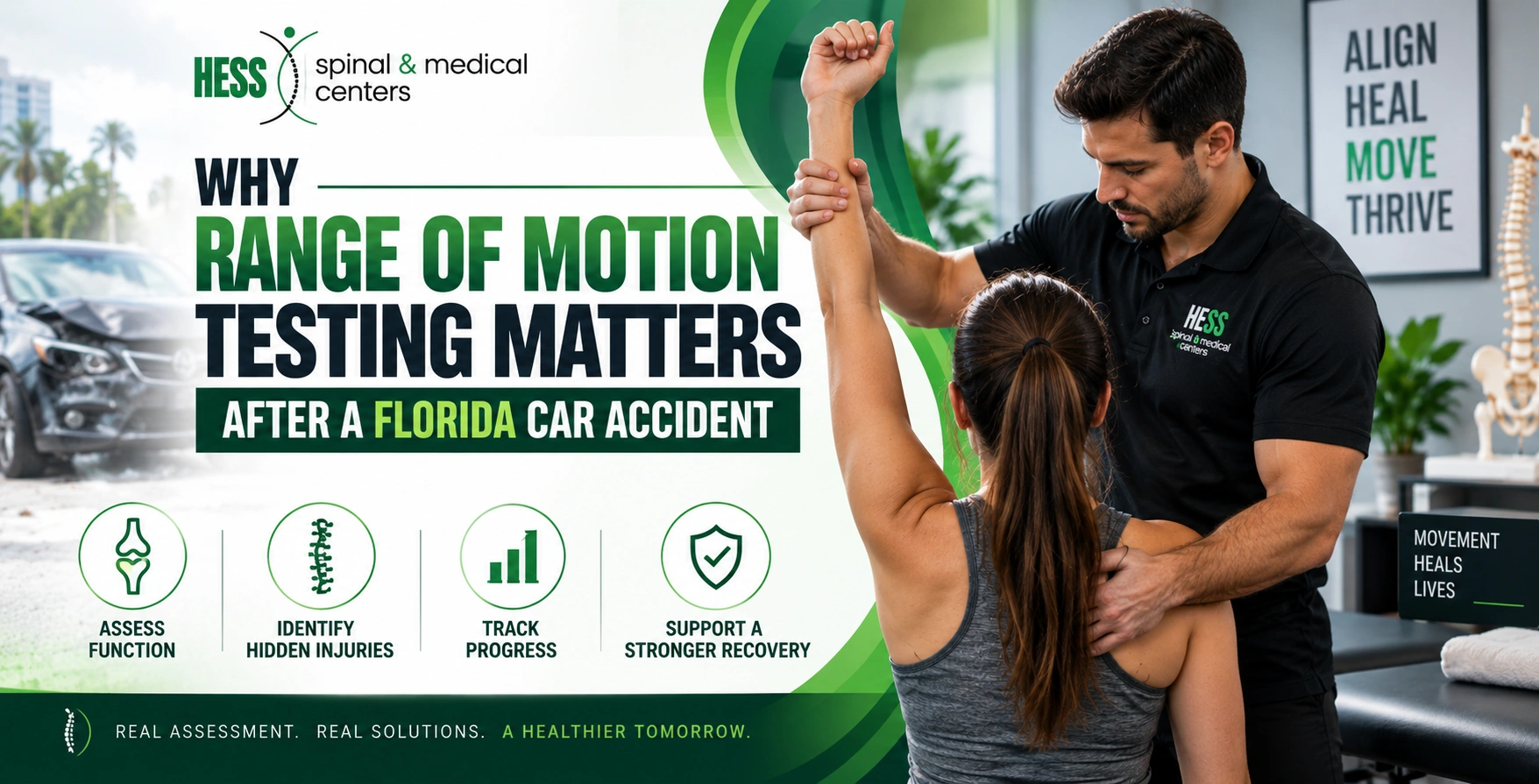
Discover why range of motion testing matters after a Florida car accident with Hess Spinal and Medical Centers. Learn how assessments help identify hidden injuries, track recovery progress, and support your medical claim.
Chiropractic Care & Injury Assessment
Why Range of Motion Testing Matters After a Florida Car Accident
The range of motion testing is a test to determine joint movement restriction caused by pain, stiffness, or swelling. It can be performed in Florida after a car accident to document a restricted range of motion. The range is measured in degrees and is used to show the amount of movement before discomfort, resistance, or pressure.
West Central Florida
(800) 618-4377
Same-day evaluations are available at Hess Spinal & Medical Centers locations across West Central Florida.
Key Points
- Measured in degrees with a goniometer, not guessed from how you describe the pain
- Required to establish a baseline before insurers will fund ongoing treatment
- Repeated at intervals to prove recovery is happening, or that it has stalled
- Tied directly to Florida's 14-day PIP treatment window under Fla. Stat. § 627.736
40%+
of Florida crashes each year result in reported injury
FLHSMV data
14
days to seek treatment or forfeit PIP benefits entirely
Fla. Stat. § 627.736
15–40%
of crash victims develop chronic neck pain, per JAAOS
JAAOS
1
What Range of Motion Testing Actually Measures
Range of motion, abbreviated as ROM, refers to the distance or angle of movement that a joint can perform actively or passively. Active movements are initiated by the patient’s own muscles, while passive ones are performed by an external source (Merck Manual). The Merck Manual makes a distinction between the two types of movement, defining active range of motion and passive range of motion. The gap between those two numbers tells a trained provider whether they are looking at muscle guarding, mechanical blockage, or something in between.
Sample Restricted Ranges vs. Clinical Normal Ranges
Sample restricted ranges seen at initial evaluation after a moderate rear-end collision, measured in degrees against clinical normal ranges.
A chiropractor doesn't eyeball this. A goniometer, a hinged protractor built for joints, gets strapped or held against the body and the angle gets read in degrees. Neck rotation, shoulder abduction, lumbar flexion, each has an established normal range, and each gets checked against it.
“It hurts when I turn my head” is a real symptom and a weak record. “Cervical rotation measured at 47 degrees to the right, down from a normal range of 80” is a clinical finding that a claims adjuster, an attorney, or a second physician can act on. Florida clinics that skip this step are handing patients a folder full of adjectives instead of evidence.
2
Why Insurers Care About a Number You've Never Heard Of
Every Florida driver's own auto policy carries Personal Injury Protection, and under Florida Statute § 627.736, that coverage pays 80% of reasonable medical expenses up to policy limits, no fault required. The catch is documentation. The statute requires initial treatment within the first 14-days of the crash and requires a qualified provider to certify that an Emergency Medical Condition did not exist for the full $10,000 benefit unlocks. The cap drops to $2,500 without that certification.
Don't Let an Undocumented Injury Cost the Claim
Hess Spinal & Medical Centers performs baseline range of motion testing at every initial visit, at all 13 Tampa Bay locations, with no upfront cost under Florida PIP.
ROM testing feeds directly into that certification. A restricted, measured, re-tested range of motion is exactly the kind of objective finding an EMC determination leans on. Skip the measurement and a provider is left arguing severity from a pain scale alone, which insurers are trained to discount.
The stakes compound under Florida's 2023 tort reform. House Bill 837 shifted the pure comparative negligence rule to the modified one, meaning that any claim in which the plaintiff was assigned more than 50% of the fault would not be able to recover anything. One of the ways of proving causation and severity in order to prevent their being argued is keeping consistent, thorough records.
3
Why Whiplash Doesn't Announce Itself on Day One
Adrenaline and inflammation take time to build. A study in PMC measuring passive cervical range of motion after whiplash found restriction patterns that correlated with long-term disability, not just day-one pain reports. Cervical range of motion is one of three components clinicians use to objectively size up a whiplash injury, alongside pain scoring and muscle spasm, since modern medicine still has no direct instrument for measuring someone else's pain.
Injury Documentation: Untested vs. ROM-Documented
- Pain reported verbally, no baseline number
- “Soreness” logged with no degree measurement
- Insurer sees a subjective complaint
- Harder to prove aggravation later
- Cervical rotation measured in degrees, both sides
- Baseline set day one, re-tested every visit
- Insurer sees a quantified functional deficit
- Improvement or plateau is provable on paper
Some critics call ROM testing imprecise. A British Columbia Medical Journal clinical guide on whiplash exams acknowledges that manual ROM testing lacks the rigor of a lab instrument, yet still calls it essential for assessment and tracking progress over time, particularly when active and passive ranges get compared side by side to separate muscular guarding from structural restriction. Imperfect and useful aren't opposites. A consistent, repeated measurement from the same clinic beats no measurement every time.
4
Tracking Recovery Instead of Guessing at It
A single ROM measurement is a snapshot. A course of measurements, taken at the same joints on a schedule, is a recovery curve. That curve either climbs toward normal function or it plateaus, and a plateau is itself clinically useful information, since it can flag the need for imaging, a referral, or a change in treatment plan.
A Typical Recovery Trajectory After Consistent Treatment
Percentage of normal cervical range of motion recovered, tracked across a 14-week treatment course. Individual results vary by injury severity and treatment adherence.
94%
of serious crashes trace back to human error, per NHTSA
NHTSA
$10K
max PIP medical benefit, contingent on EMC certification
Fla. Stat. § 627.736
2 yrs
statute of limitations for injury claims under HB 837
Florida HB 837
5
How Hess Spinal & Medical Centers Builds This Into Every Visit
Hess Spinal & Medical Center’s range of motion testing isn't an add-on ordered after a complaint escalates. It's part of the individual treatment plan built during the first visit, alongside digital radiography and a physician evaluation. The initial range of motion is then compared to later exams to see the pattern of progress or decline over time within the patient’s treatment chart.
"The patient doesn’t have to say that it feels restricted. We measure it, write it down, and measure it again next visit. That's what separates a real recovery record from a rough estimate."
Dr. Stephen Hess, Hess Spinal & Medical Centers
Clinical Team Statement, Tampa Bay Area Locations
The clinic's multi-disciplinary team of Board Certified Medical Doctors, Doctors of Osteopathic Medicine, and Doctors of Chiropractic work from the same chart, which matters when a case moves from initial care into injury rehabilitation built specifically to restore lost range and independence. With 13 locations throughout Hillsborough, Pinellas, Polk, Pasco and Hernando counties, same-day and walk-in availability make the 14-day PIP time-frame a non-issue for the first place.
"Clinical measurement of range of motion is a fundamental evaluation procedure. Objective measurements of ROM and correct interpretation of the results can have a substantial impact on treatment decisions."
Clinical Measurement of Range of Motion Review of Goniometry
Peer-reviewed literature, physical therapy field
6
Where This Matters Most in West Central Florida
Traffic patterns in Tampa Bay leave plenty of Florida drivers hanging on the rear end or side ends of vehicles waiting to get back on the road each year, from I-275 to Gandy Blvd. Local crash volume keeps ROM documentation relevant county by county.
County-by-County ROM Documentation Relevance
| County | Common Collision Type | Why ROM Testing Matters Here |
|---|---|---|
| Hillsborough | Rear-end, highway merge | High I-275/I-4 volume means repeat low-speed impacts and cumulative cervical strain |
| Pinellas | Side-impact, intersection | Dense signalized corridors increase T-bone mechanics affecting shoulder and lumbar ROM |
| Polk | Rear-end, rural highway | Higher speed differentials on US-98 and SR-60 raise whiplash severity |
| Pasco | Rear-end, suburban arterial | Growing commuter corridors along SR-54 see rising low-speed crash counts |
Get Your Baseline on Record Before the 14-Day Window Closes
Walk-ins are welcome at all 13 Hess Spinal & Medical Centers locations across the Tampa Bay area
Frequently Asked Questions
FAQ
Is my range of motion fine if I got a normal X-ray?
No. X-rays show bone. Restricted range of motion is often a soft-tissue and muscular finding that imaging alone won't catch.
Can I request my range of motion numbers in writing?
Yes. Ask your provider for a copy of your chart notes, which should include degree measurements at each visit.
Will my insurance company ever dispute a ROM measurement?
It happens. That's why repeated, consistent measurements from the same clinic hold up better than a single isolated reading.
Is range of motion testing painful?
It shouldn't be. A clinician stops at the point where pain or resistance begins, that stopping point is the measurement itself.
How soon after a crash should range of motion be tested?
At the first visit, ideally within days and always inside Florida's 14-day PIP window.
Disclaimer
This article provides general information and does not constitute medical advice. Please contact Hess Spinal & Medical Centers for a personalized diagnosis and treatment.